;%20}%20.st1%20{%20fill:%20url(%23SVGID_2_);%20}%20.st2%20{%20fill:%20url(%23SVGID_3_);%20}%20%3c/style%3e%3cg%3e%3clinearGradient%20id='SVGID_1_'%20gradientUnits='userSpaceOnUse'%20x1='299.5347'%20y1='533.1815'%20x2='704.0945'%20y2='937.7413'%3e%3cstop%20offset='0'%20style='stop-color:%23929497;stop-opacity:0'%20/%3e%3cstop%20offset='1'%20style='stop-color:%23929497'%20/%3e%3c/linearGradient%3e%3cpath%20class='st0'%20d='M547.25,485.48l311.33,203.89c33.22,21.76,33.22,70.44,0,92.2L547.25,985.45c-27.6,18.07-63.28,18.07-90.87,0%20L145.04,781.56c-33.22-21.76-33.22-70.44,0-92.2l311.33-203.89C483.97,467.4,519.66,467.4,547.25,485.48z'%20/%3e%3clinearGradient%20id='SVGID_2_'%20gradientUnits='userSpaceOnUse'%20x1='7103.2393'%20y1='298.7205'%20x2='6698.6792'%20y2='703.2803'%20gradientTransform='matrix(-1%200%200%201%207402.7739%200)'%3e%3cstop%20offset='0'%20style='stop-color:%2300ADEE;stop-opacity:0'%20/%3e%3cstop%20offset='1'%20style='stop-color:%2300ADEE'%20/%3e%3c/linearGradient%3e%3cpath%20class='st1'%20d='M547.25,251.01L858.59,454.9%20c33.22,21.76,33.22,70.44,0,92.2L547.25,750.99c-27.6,18.07-63.28,18.07-90.87,0L145.04,547.1c-33.22-21.76-33.22-70.44,0-92.2%20l311.33-203.89C483.97,232.94,519.66,232.94,547.25,251.01z'%20/%3e%3clinearGradient%20id='SVGID_3_'%20gradientUnits='userSpaceOnUse'%20x1='7103.2393'%20y1='64.2594'%20x2='6698.6792'%20y2='468.8192'%20gradientTransform='matrix(-1%200%200%201%207402.7739%200)'%3e%3cstop%20offset='0'%20style='stop-color:%23F69222;stop-opacity:0'%20/%3e%3cstop%20offset='1'%20style='stop-color:%23F69222'%20/%3e%3c/linearGradient%3e%3cpath%20class='st2'%20d='M547.25,16.55l311.33,203.89%20c33.22,21.76,33.22,70.44,0,92.2L547.25,516.52c-27.6,18.07-63.28,18.07-90.87,0L145.04,312.64c-33.22-21.76-33.22-70.44,0-92.2%20L456.38,16.55C483.97-1.52,519.66-1.52,547.25,16.55z'%20/%3e%3c/g%3e%3c/svg%3e)
BaSyx Digital Product Passport
Off-the-shelf solution for Digital Product Passports across the DPP standard family, with EN 18222 lifecycle operations at the API boundary.
Try the implementation yourself
Postman collection, Docker Compose files, and a sample DPP for running the service locally.
Source repository
eclipse-basyx/basyx-go-componentsCurrent release
v1.0.0-rc.6
Organizations already using Eclipse BaSyx can expose standardized Digital Product Passports directly from their existing Asset Administration Shells and Submodels.
Why this matters
A practical route from DPP standards to working software
Before the endpoint details, this is the value path: standards-aligned API behavior, an AAS and BaSyx implementation approach, and Fraunhofer IESE support for applying it in real projects.
Standards-aligned DPP API
The service follows the DPP API mapping around lifecycle operations, product ID resolution, historical reads, and element-level access.
AAS and BaSyx implementation path
DPP requests are mapped to Asset Administration Shells and submodels so existing BaSyx environments can expose passport data through a DPP API.
Fraunhofer IESE project support
Fraunhofer IESE can help assess readiness, prototype integration, and transfer DPP concepts into applied research or software projects.
Technical deep dive
API operations behind the DPP service
After the value and implementation path are clear, this section shows what implementation teams can call: lifecycle operations, product identifier resolution, historical reads, and fine-granular element access.
OpenAPI contract preview
Rendered from the DPP service OpenAPI contract for implementation planning. Each operation is listed individually instead of being grouped into a summary.
DPP Life Cycle
DPP Fine Granular
Conformance
Compliance needs more than one API standard
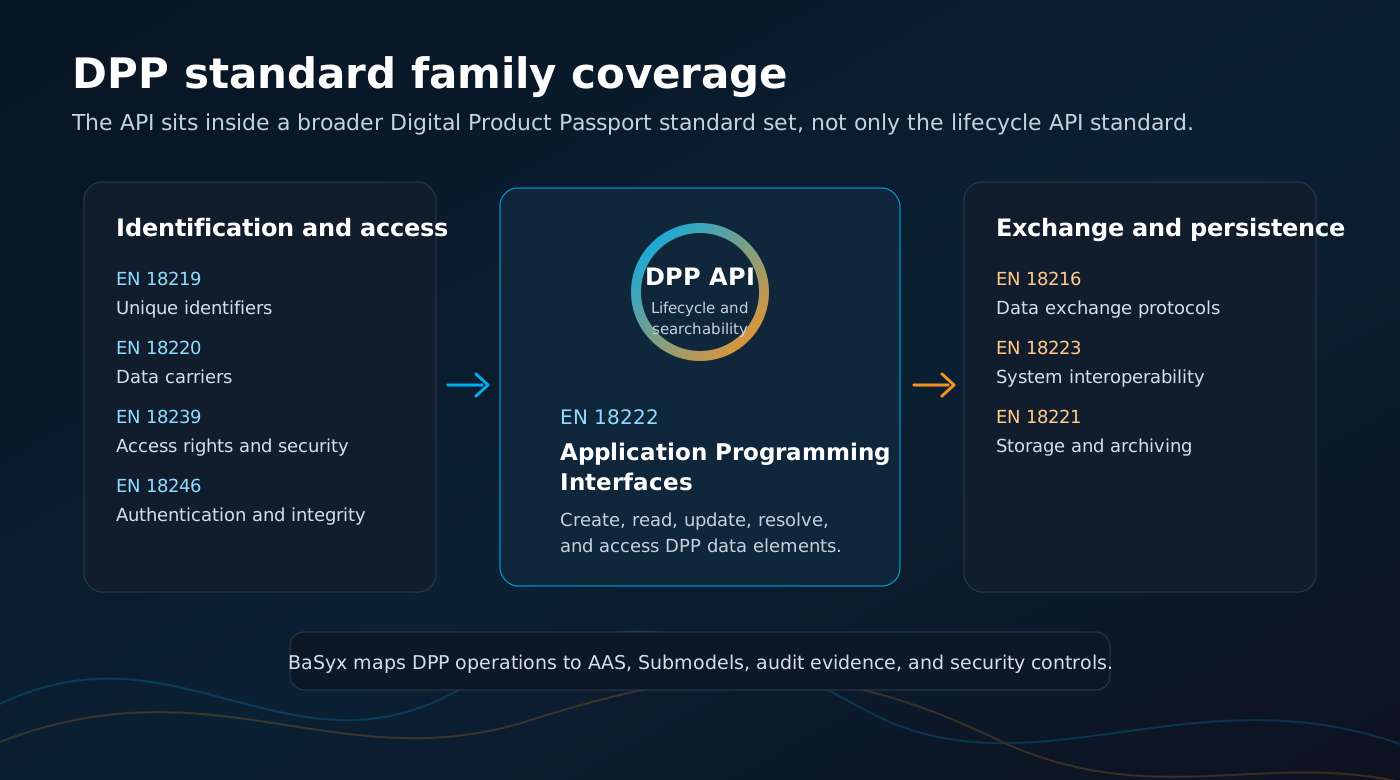
The API standard is only one part of DPP readiness. The implementation is designed around the broader EN 182xx standard family: identifiers, data carriers, exchange protocols, interoperability, storage, security, and data integrity all affect how a passport can be issued and trusted. IDTA annexes describe how AAS and the DPP standards can evolve together.
EN 18219:2026
Unique identifiers
Unique product, operator, facility, and passport identifiers used for lookup and trust.
EN 18220:2026
Data carriers
Carrier concepts for connecting physical products with their passport access points.
EN 18216:2026
Exchange protocols
Data exchange protocols used when DPP data moves between systems and actors.
EN 18222:2026
API lifecycle
Lifecycle management, searchability, and fine-granular DPP API methods.
EN 18223:2026
System interoperability
The DPP metamodel and interoperability rules that enable exchange across systems.
EN 18221:2026
Persistence
Storage, archiving, and persistence expectations for DPP records over time.
EN 18239:2026
Access and confidentiality
Access rights, information system security, and business confidentiality requirements.
EN 18246:2026
Data authenticity
Authentication, reliability, and integrity of DPP data and exchanged documents.
Readiness context
What the standards coverage means in practice
The standards grid describes the technical coverage. These notes explain the deployment and governance topics an operator still needs to handle around that API.
Regulatory context
The page positions the API for ESPR-driven DPP rollout and related operational expectations such as CRA and NIS2. These regulations still require organization-specific compliance work.
Security and auditability
BaSyx can support traceability through ABAC-oriented access control, signed reads, append-only history, hash chains, audit metadata, and optional WORM evidence. Enabling those controls supports security obligations but does not automatically make an operator compliant.
AAS as the data foundation
The AAS approach turns DPP delivery into an extension of a Digital Twin strategy. Battery passport implementations already use IDTA Submodel Templates, providing a concrete blueprint for future ESPR product groups.
Implementation notes
BaSyx translates between DPP requests and AAS data
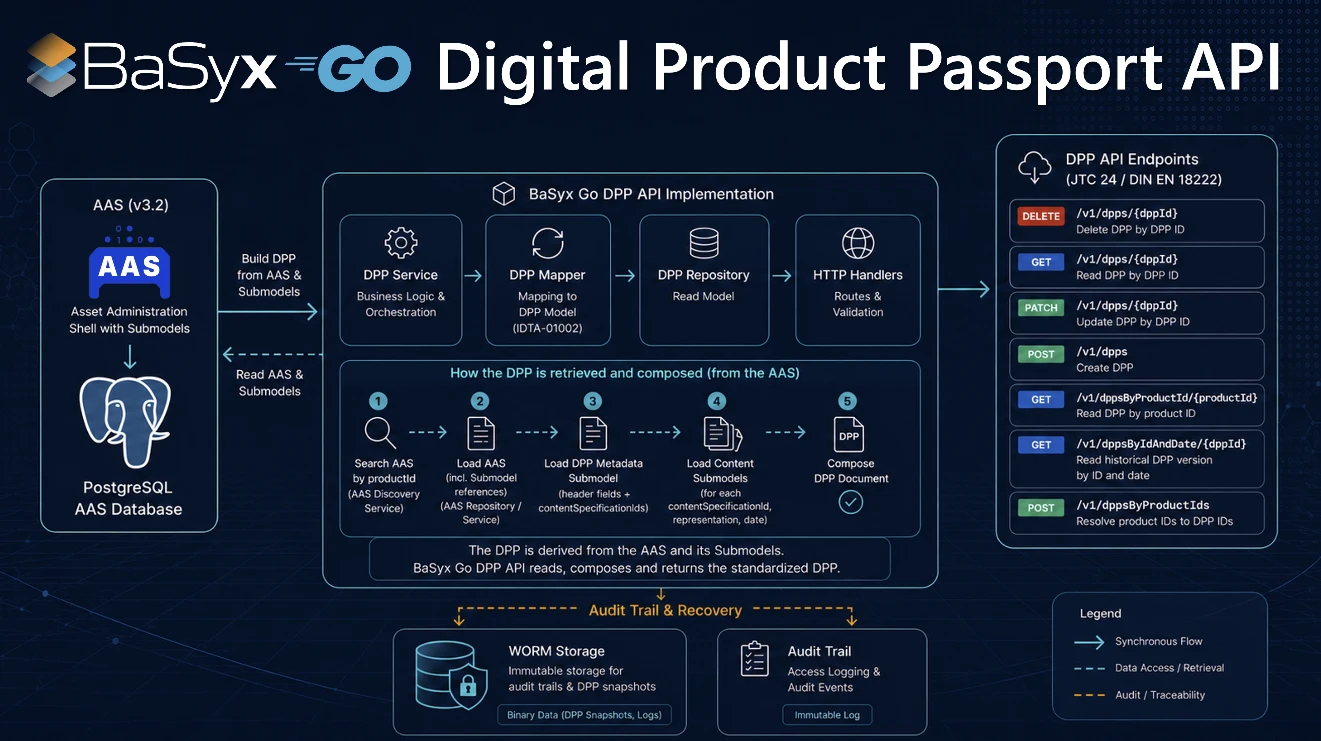
AAS is a practical foundation for DPP delivery because product data is already structured as modular shells and submodels. The BaSyx implementation maps DPP requests to AAS data, composes passport documents from reusable submodels, and decomposes write requests back into AAS resources.
Automatic model mapping
The DPP mapper translates in both directions between the API-facing DPP model and AAS/Submodel data structures, so DPP clients do not need to understand the underlying AAS representation.
DPP composition from AAS
For reads, the service resolves product identifiers, loads the shell and submodel references, gathers DPP metadata and content submodels, and composes the DPP document returned by the API.
Audit trail and recovery
The architecture includes audit trail and recovery concepts, including append-only history, immutable evidence options, and access logging, so deployments can trace how DPP data was retrieved or changed.
Work with Fraunhofer IESE
Ready to move your DPP project forward?
Fraunhofer IESE supports companies and research partners from early DPP orientation to implementation, evaluation, and transfer into real software systems. Talk to us when you need technical guidance, project support, or a partner for applied research around Digital Product Passports.
Project and Implementation Support
Need help applying Eclipse BaSyx and the Asset Administration Shell to your own Digital Product Passport project? We can help clarify the architecture, data model, API integration, and deployment path.
Research Collaboration
Exploring DPPs, AAS, Digital Twins, or Dataspaces in a funded project, pilot, or consortium? We can contribute research expertise, prototypes, and transfer experience.
Your path with Fraunhofer IESE
Assess readiness
We help teams understand DPP expectations, evaluate AAS and BaSyx fit, identify system gaps, and shape a realistic roadmap before larger implementation decisions.
Prototype and integrate
We help translate DPP requirements into BaSyx and AAS services, including model mapping, example setups, API integration, and deployment-oriented engineering choices.
Transfer and support
We support applied research, pilots, transfer into software projects, and project support where DPPs meet Digital Twins, Dataspaces, security, and product life cycle data.
Common project questions
Short answers for teams evaluating whether this implementation fits their Digital Product Passport path.
People behind the project
The work is driven by researchers and engineers at Fraunhofer IESE who connect Digital Product Passport requirements with practical BaSyx and Asset Administration Shell implementation.